
Why Buying an Original Software License is Important
You have probably seen them: Windows 11 Pro keys on eBay for $4.99, “lifetime activation” offers on G2A and Kinguin, and USB sticks preloaded with “genuine” Office installations sold at flea markets. The pitch is always the same. Why pay full price when you can get the same thing for pennies?
Here is the uncomfortable truth: that cheap Windows 11 Pro key is almost never what it claims to be. It may be stolen, volume-licensed to a corporation that never authorized resale, or worse, bundled with malware that turns your PC into a botnet node. In this guide, we explain why buying an original software license is important, and we take a hard look at the dangers of pirated Windows keys on eBay, G2A, and Kinguin.
Whether you are a home user building a new PC, a freelancer upgrading your workstation, or an IT manager provisioning a small office, the licensing decisions you make affect your security, your legal exposure, and your long-term costs. This article covers all three, with practical, no-nonsense guidance you can act on today. For a broader overview of licensing models, see our Ultimate Guide to Software Licenses.
1. What “Original” Actually Means in Software Licensing
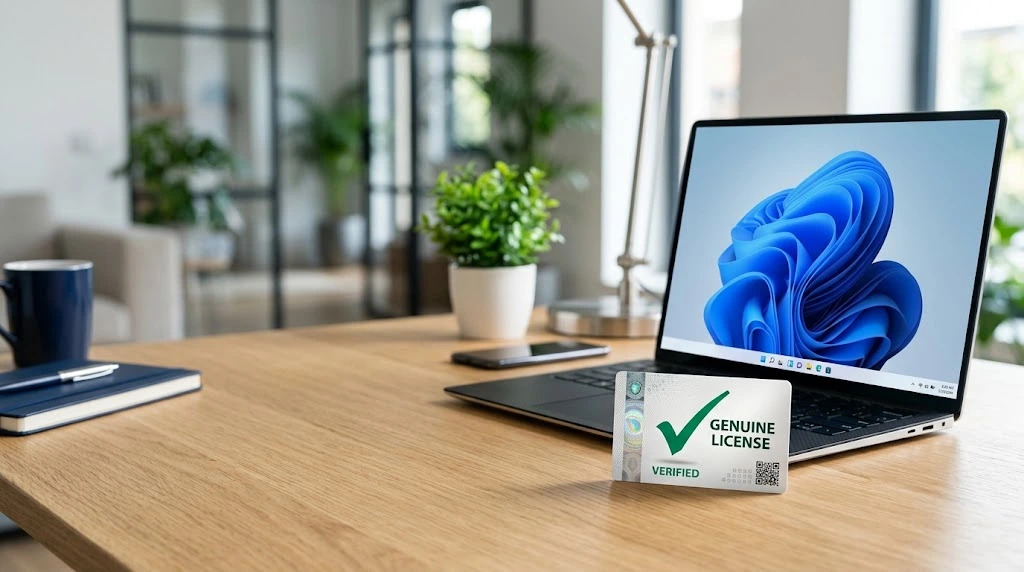
When we say “original” or “genuine” software license, we mean a license that was legitimately issued by the software publisher (Microsoft, Adobe, etc.) and transferred to you through an authorized channel. An original software license can come from a direct purchase from Microsoft, a retail box, or an authorized reseller of surplus OEM and volume licenses.
A genuine license gives you three things a pirated key never can:
- Legal ownership: the right to use the software under the terms of the EULA.
- Full update access: security patches, feature updates, and official support.
- Transferability (Retail) or hardware binding (OEM): clear rules about what happens when you upgrade.
It is also important to understand the terminology. A product key is the 25-character alphanumeric code that unlocks the software. A digital license is an entitlement stored in your Microsoft account that does not require a key at all on reinstall. An activation key is a broader term that can refer to either, and vendors sometimes use them interchangeably, which causes confusion. Our Ultimate Guide to Software Licenses covers this in more detail.
Pirated keys skip all of this. They may activate today and fail tomorrow, or worse, they may activate a modified version of Windows that has been tampered with before it ever reached your PC. That is the first reason an original software license is worth the small extra cost.
2. The Real Dangers of Cheap Keys on eBay, G2A, and Kinguin
Whether you find a $5 Windows 11 Pro key cheap listing on eBay, a “guaranteed” key on G2A, or a suspicious deal on Kinguin, grey-market platforms share the same underlying risks. And if you have ever searched “are cheap Windows keys legit Reddit”, “G2A Windows key safe”, or “Kinguin Windows key safe”, you already know the community consensus: the savings are rarely worth the gamble.
Here is what actually happens when you buy a suspiciously cheap Windows key from one of these marketplaces:
The “Volume License” Scam (MAK Keys)
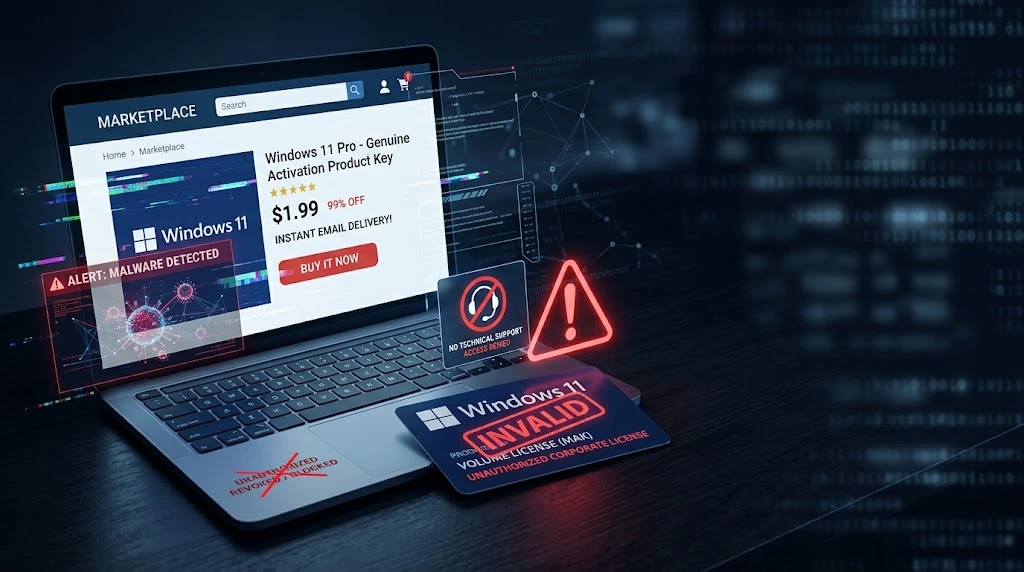
Many grey-market sellers unload keys from Microsoft Volume Licensing agreements, specifically MAK (Multiple Activation Key) keys. These keys are meant for corporate deployments under a specific organization, not for resale to individual consumers. When Microsoft audits the volume license, every key under that agreement is flagged and deactivated. You wake up one morning to a “Windows is not activated” watermark and a seller who has vanished.
This is one of the most common forms of grey-market activity because the keys are technically genuine. They were issued by Microsoft, but their resale violates the terms under which the organization acquired them. When the audit hits, the keys stop working regardless of who is using them.
The Key Generator Problem
Some sellers use key generators (KG) to produce algorithmically valid keys that were never issued by Microsoft. These keys sometimes activate because Microsoft’s servers haven’t yet blacklisted the pattern. They stop working the moment Microsoft updates its revocation list, which happens regularly.
The Stolen Developer Subscription Problem
Another major source of grey-market keys is abused developer subscriptions: MSDN keys, TechNet keys, and DreamSpark / Azure Dev Tools for Teaching keys. These are issued to developers and students for testing purposes, and they are explicitly non-transferable. When the subscription is audited or the student graduates, every key under that account is revoked.
The “Pre-Activated USB” Trick
Another marketplace staple: a USB drive sold as a “Windows 11 installer with built-in activation.” What you are actually buying is a modified ISO with an activation crack baked in, often a KMS emulator such as KMSPico or a MAS (Microsoft Activation Scripts) loader. These modified installers frequently disable Windows Update, inject registry changes, and open backdoors. They also violate the Windows EULA before you have even finished installation.
The “Office 2021 Pro Plus” Account Sharing Scam
Pirated keys are not limited to Windows. A recurring question among buyers is: is Office 2021 Professional Plus legit on discount sites? On marketplaces like eBay and Kinguin, sellers frequently sell single corporate volume keys to dozens of customers or send “pre-activated account credentials” that share a single enterprise tenant. When Microsoft detects concurrent logins across different geographic locations, the entire tenant is terminated, permanently wiping access to your documents and apps.
The “Digital License” Bait
Some sellers advertise a “digital license” but deliver a product key that has already been used on another machine. Microsoft’s digital licensing system ties entitlements to accounts, so a key that works once may trigger a “license already in use” error the second time. The seller usually blames you, then stops responding.
3. Malware, Keyloggers, and the Hidden Cost of Cheap Keys
The financial cost of a $5 key is trivial compared to what it can cost you later. Security researchers have repeatedly found that cracked Windows installers and “activator” tools, including popular KMS emulators like KMSPico and MAS scripts, are among the most common malware delivery vehicles on the internet.
Common payloads bundled with pirated Windows keys include:
- Keyloggers that capture banking credentials, email passwords, and crypto wallet seeds.
- Cryptojackers that silently mine cryptocurrency using your CPU and GPU.
- Ransomware droppers that encrypt your files and demand payment.
- Backdoor RATs (Remote Access Trojans) that give attackers full control of your machine.
- Botnet clients that enlist your PC in DDoS attacks without your knowledge.
Because activation cracks often require you to disable Windows Defender and exclude folders from real-time scanning, your system is left wide open during the exact moment malware is being installed. Even if the key itself is “clean,” the crack that activates it usually is not.
| Factor | $5 Grey-Market Key | Genuine Original License |
|---|---|---|
| Legal Ownership | No, stolen or unauthorized | Yes, under publisher EULA |
| Malware Risk | High (KMS emulators, MAS scripts, modified ISOs) | None (clean official media) |
| Activation Stability | Can be revoked at any time | Permanent (Retail) or hardware-bound (OEM) |
| Security Updates | Often blocked or broken | Full access to all patches |
| Support & Refunds | None, seller disappears | Vendor support + replacement guarantee |
| Business Use | Illegal, audit exposure | Fully compliant |
4. Activation Bans, Revocation, and the “It Worked Yesterday” Problem
One of the most frustrating aspects of pirated keys is their unpredictability. A key that activates today may be deactivated next week, through no action of your own. Microsoft regularly runs automated audits that flag:
- Keys activated from more than the licensed number of machines.
- Keys originating from known volume-license leaks (MAK abuse).
- Keys generated by known key generators (once patterns are identified).
- Keys tied to chargebacks or fraudulent credit card purchases.
- Keys sourced from abused MSDN, TechNet, or Azure Dev Tools subscriptions.
When your key is revoked, you do not get a refund from eBay, G2A, or Kinguin. You do not get a replacement. You get a notification that Windows needs activation, restricted personalization, and a nagging watermark. In enterprise environments, a deactivated Windows license can also trigger compliance flags during a software audit.
What happens if your Windows license expires or is revoked? Practically, Windows continues to run, but with limitations: you cannot change the wallpaper or theme, you see a persistent “Activate Windows” watermark, and Windows Update may stop delivering certain updates. Furthermore, with the Windows 10 end of support milestone now passed, running an unauthorized or broken installation cuts you off entirely from critical security patches, leaving your PC wide open to newly discovered vulnerabilities.
The Truth About “Windows 11 Pro Lifetime License” Deals
Sellers love advertising a Windows 11 Pro lifetime license for pennies. What they actually mean is: the key will only work until Microsoft’s servers run an automated validation sweep. There is no guarantee, no contract, and no recourse once the vendor disappears.
If your key is blacklisted by Microsoft or your Windows 11 product key is not working following a system update, Windows suddenly fails activation and throws Error 0xC004C003 (The activation server determined the specified product key is blocked) or Error 0xC004F050.
5. OEM vs Retail vs Volume: Why License Type Matters
Not all genuine licenses are the same. Understanding the difference between OEM, Retail, and Volume licenses is essential to making a smart purchase, and it is one of the biggest gaps in online software content today. When buyers search for volume license vs retail, they usually find vendor marketing rather than plain-English guidance. Here is the honest comparison.
| Feature | OEM | Retail | Volume |
|---|---|---|---|
| Transferable? | No (bound to first motherboard) | Yes (to new PCs) | No (tied to organization) |
| Upfront Cost | Low | High | Lowest (per seat) |
| Support | OEM partner only | Publisher + reseller | Organization IT |
| Best For | New PC builds | Upgraders, professionals | Enterprises (25+ seats) |
| Resale Legality | Legal if authorized surplus | Legal (EU & many regions) | Not legal outside organization |
If you are building a new PC and do not plan to swap the motherboard, an OEM license is the cost-effective choice. If you upgrade frequently or manage multiple machines, a Retail license pays for itself through transferability. If you are an enterprise, Volume Licensing is the compliant route, but individual resale of those keys is not legal. Choosing the right original software license type saves you money and keeps you compliant.
6. Why an Original Software License Matters: Legal and Compliance Risks
Software piracy is not a victimless crime, and it is not just a “personal choice.” Depending on your jurisdiction, using pirated software can expose you to:
- Civil liability: software publishers can pursue damages for copyright infringement.
- Statutory penalties: in many countries, fines scale with the number of infringing installations.
- Business audit failure: non-compliance with software licensing can void insurance, breach client contracts, and fail ISO/SOC2 audits.
- Reputational damage: a business caught using pirated software loses trust fast.
For individuals, the risk is lower but not zero. For businesses, the risk is existential. This is precisely why buying an original software license is important. It is not just about morality, it is about legal and operational safety. You can read the official Microsoft Software License Terms to see exactly what rights a genuine license grants.
There is also a nuance many buyers miss: is buying OEM software legal? The answer depends on where you are and how the key was sourced. In the EU, the UsedSoft v. Oracle ruling established that the resale of used software licenses can be lawful under certain conditions. In the US, the picture is more complex and varies by publisher and contract. Always check the EULA and buy from a reseller that is transparent about its sourcing.
7. How to Spot a Pirated or Grey-Market Key Before You Buy
Before you click “Buy It Now” on any marketplace listing, whether on eBay, G2A, Kinguin, or a forum classified, run through this quick checklist:
- Price reality check. Windows 11 Pro retail is around $199. A legitimate surplus OEM key might sell for $15 to $40. Anything under $10 is a red flag.
- Seller history. Does the seller have a long, verifiable reputation? Do negative reviews mention deactivated keys?
- Delivery method. Genuine resellers deliver a key. Scammers deliver a script, a third-party activator, or a “call this number” instruction.
- License type transparency. Legitimate sellers clearly state whether the key is OEM, Retail, or Volume. Ambiguity is a warning sign.
- No account sharing. If the seller wants to log into your Microsoft account to “activate” the key, walk away immediately.
- Warranty and refund terms. Reputable sellers stand behind their keys. If there is no refund policy, there is no accountability.
- No KMS or MAS instructions. If the listing mentions a “KMS activator,” “KMSPico,” “MAS script,” or asks you to run
slmgr /skmswith a third-party server address, it is pirated.
8. How to Check if Your Windows License is Genuine
If you recently purchased a key, or want to know how to check if Windows 10 or Windows 11 is genuine on a newly acquired PC, you can verify it in seconds using built-in Windows diagnostic tools. No third-party software required.
Open Command Prompt as Administrator (press Win + R, type cmd, then right-click and choose “Run as administrator”), and run the following commands:
The slmgr /xpr command displays the activation expiration. A genuine Retail or OEM license will report “The machine is permanently activated.” If it shows a date, typically 180 days from the last KMS renewal, you are running an illegal volume KMS key.
Next, inspect the license channel itself:
The slmgr /dli command displays your license information. In the output, look for the Product Key Channel line. Legitimate consumer licenses show OEM or Retail. If you see VOLUME_KMSCLIENT or Volume:MAK, your license was activated through an unauthorized channel and is at risk of revocation. You can cross-check your results against Microsoft’s official activation guide.
9. The Smarter Alternative: Genuine OEM and Retail Licenses
The good news is that you do not have to choose between paying full retail and risking a pirated key. Authorized resellers of surplus OEM and volume licenses offer a legitimate middle ground. Every key sold this way is a genuine original software license that activates cleanly and stays activated.
- OEM licenses: significantly cheaper than retail, bound to the first motherboard, ideal for new PC builds.
- Retail licenses: fully transferable between machines, ideal for upgraders and professionals.
- Volume surplus licenses: legally resold from enterprise overstock, fully legitimate when sourced through authorized channels.
At LicensesVault, every key we sell is sourced from authorized channels, delivered instantly, and backed by activation support. You get the savings without the malware, the revocation risk, or the legal exposure.
If you need to replace a revoked or unverified key today, choose from our verified, audit-proof licenses:
- Buy a Genuine Windows 11 Pro OEM Key: cost-effective, genuine activation for new PC builds.
- Buy a Windows 11 Home OEM Key: cost-effective, genuine activation for new PC builds.
- Buy an Office 2021 Professional Plus License: one-time purchase, perpetual activation without recurring subscriptions.
- Buy a Windows 10 Professional Retail Key: fully transferable, genuine lifetime activation.
Ready to Stop Gambling on eBay, G2A, and Kinguin Keys?
Get a genuine, verified Windows or Office license delivered to your inbox in minutes, with full activation support and a replacement guarantee.
Buy Genuine Windows & Office Licenses OnlineFrequently Asked Questions (FAQ)
Are cheap Windows keys legit?
Most ultra-cheap Windows keys on marketplaces like eBay, G2A, and Kinguin are not legitimate. They typically come from stolen corporate Volume Licensing agreements (MAKs), abused developer subscriptions (MSDN or Azure Dev Tools), or unauthorized key generators. Genuine OEM and Retail licenses have a realistic price floor, so anything drastically below that is a red flag. If you want a safe purchase, buy an original software license from an authorized reseller with a refund policy.
How do I check if my Windows is genuine?
Open Command Prompt as Administrator and run slmgr /xpr. A genuine Retail or OEM license will display “The machine is permanently activated.” If it shows an expiration date, it is an illegal volume KMS key. Run slmgr /dli to inspect your license channel. Look for OEM or RETAIL rather than VOLUME_KMSCLIENT.
Is G2A safe for software keys?
G2A and similar grey-market platforms are not authorized resellers. While some keys may activate, many come from stolen credit cards, chargebacks, or volume-license leaks. When the original owner disputes the charge or Microsoft audits the volume agreement, the key is revoked without warning. G2A’s buyer protection does not cover deactivated keys in most cases. The same applies to Kinguin and similar marketplaces.
Is Kinguin safe for Windows keys?
Kinguin, like G2A, is a grey-market marketplace, not an authorized reseller. Windows keys sold there frequently originate from volume-license leaks, chargebacks, or abused developer subscriptions. When Microsoft revokes the underlying volume agreement, every key sourced from it stops working, and Kinguin’s buyer protection rarely covers deactivated keys. If you want a Windows license that stays activated, buy an original software license from an authorized reseller.
What happens if a pirated Windows key gets deactivated?
Your Windows installation reverts to an unactivated state. Personalization is locked, some updates are restricted, and a watermark appears on the desktop. eBay, G2A, and Kinguin sellers rarely refund deactivated keys, so you lose both the money and the activation. In a business setting, the deactivation can also trigger compliance flags during an audit.
Is buying an OEM software license legal?
OEM licenses are legally intended for system builders, but reselling surplus OEM keys is generally legal in most jurisdictions when done through authorized channels. Always check the EULA and buy from a reseller that is transparent about its sourcing.
Can I transfer an OEM Windows license to a new PC?
No. OEM licenses are permanently bound to the first motherboard they were activated on. If you replace the motherboard, the license is forfeited and you must purchase a new license. If you upgrade frequently, choose a Retail license instead. It is transferable.
Is Office 2021 Professional Plus legit on discount sites?
Most ultra-cheap Office 2021 Professional Plus keys on discount marketplaces are not legitimate. They are typically single corporate volume keys resold to dozens of buyers, or shared enterprise tenant credentials. When Microsoft detects concurrent logins across different geographic locations, the entire tenant is terminated, permanently wiping access to your documents and apps. Buy an original software license from an authorized reseller to avoid this risk.
Can I buy a Windows 11 Pro key from a third party?
Yes, but only from an authorized reseller of surplus OEM or Retail licenses. Third-party marketplaces like eBay, G2A, and Kinguin are not authorized resellers, and most ultra-cheap keys fail within months. Buy from a reseller that publishes a refund policy, delivers keys via encrypted email, and offers activation support.
How can I verify a genuine software license before buying?
Check that the seller publishes a clear refund and replacement policy, delivers keys via encrypted email or a secure dashboard, offers activation support, and prices OEM and Retail keys realistically. Avoid sellers who ask you to run scripts, disable antivirus, or share account credentials.
Why is buying an original software license important for businesses?
Businesses face software audits, compliance requirements, and legal liability for unlicensed software. Using pirated keys can void contracts, fail security certifications, and result in statutory penalties. An original software license is the only defensible option in a commercial environment, and it also protects you from the malware risks that come with cracked installers.